
UVB lighting is an emerging area of guinea pig husbandry. Like many mammals, guinea pigs can produce vitamin D₃ in their skin through exposure to UVB light. Vitamin D₃ plays a central role in calcium metabolism—and calcium, in turn, is essential to bone health, dental health, and urinary tract function. That chain of connections is why UVB has drawn interest as a potential husbandry tool, even though it's not yet a standard or required part of guinea pig care.
Guinea pigs that live indoors get very limited natural UVB exposure. Ordinary window glass blocks most UVB radiation, so a guinea pig napping in a sunny windowsill isn't getting meaningful UVB—even though it looks like direct sun.
This article is based on a combination of the formal research available and our own long-term, hands-on experience using UVB with guinea pigs. It should be read as an experimental protocol we've developed for our own animals, not an established veterinary recommendation. Our approach may continue to evolve as more guinea-pig-specific research is published.
Possible Benefits of UVB
To understand why UVB matters, it helps to walk through the chain it supports:
- UVB exposure creates vitamin D₃ production. When skin is exposed to UVB light, the body synthesizes vitamin D₃.
- Vitamin D₃ improves calcium absorption. Vitamin D₃ helps the gut absorb calcium from food, and helps the body direct that calcium where it's actually needed—toward building and maintaining strong bones and healthy teeth. This matters especially for guinea pigs, since their teeth grow continuously throughout life and depend on a steady supply of well-utilized calcium.
- Efficient use of calcium means less excess calcium. When calcium is being absorbed and routed to bone and teeth effectively, less unused calcium is left over to be filtered out through the urinary tract.
- Less excess calcium lowers the risk of bladder stones. Excess calcium passing through the urinary tract is one contributing factor in bladder stone formation, so supporting healthy vitamin D₃ status is one piece of a strategy to help manage that risk.
That's the theoretical basis for why we started experimenting with UVB. But it's important to be clear about the limits of this reasoning: UVB has not been definitively proven to prevent bladder stones in guinea pigs, and it hasn't been established as necessary for normal bone or dental development either. Guinea pigs can and do grow normally on adequate dietary calcium and vitamin D alone. Stone formation and skeletal/dental health are both influenced by many interacting factors: the balance of calcium, magnesium, and phosphorus in the diet, hydration, genetics, and individual metabolism. Vitamin D₃ is one variable in a complex system, not a standalone fix, and it can't be considered separately from a guinea pig's overall diet and health.
Our Experience
We've used UVB with guinea pigs for more than five years, treating it as an optional addition to good overall care—never a replacement for a healthy diet, adequate hydration, appropriate housing, or veterinary care. Our approach has stayed deliberately conservative: relatively low UVB exposure, paired with unrestricted access to areas outside the UVB zone at all times.
Over that five-year period, we haven't observed any adverse effects in our animals that we could attribute to UVB exposure. We've also noticed less calcium sediment in urine and fewer reported bladder stones among guinea pigs with UVB access who are otherwise on a healthy, appropriate diet. That said, these observations are anecdotal, based on animals under our own care, and are not a substitute for controlled research.
The limited research available is encouraging but also urges caution. A six-month University of Illinois study (Watson, 2014) found that guinea pigs given daily UVB had higher, stable vitamin D₃ levels than guinea pigs without it. The UVB group also had modestly higher calcium available for use in the body—consistent with the calcium-use benefits described above. However, the study also found thicker corneas in the UVB group, although no damage or vision problems were detected on exam. Researchers think this may be a protective adaptation rather than an injury, but it's still a real physical change worth taking seriously (Watson, 2014; Mancinelli, 2016). This is one reason we favor a conservative, modest approach to UVB rather than maximizing exposure.
Experimental Setup
The following outlines our current approach with UVB lighting. These parameters are based on our personal experience and should not be considered an established veterinary standard.
Our target exposure is approximately 0.7–1.0 UVI. This is a relatively low level of UVB exposure that is generally considered safe for many animal species. An optimal UVI for guinea pigs has not been established, so we have chosen this range as a conservative target.
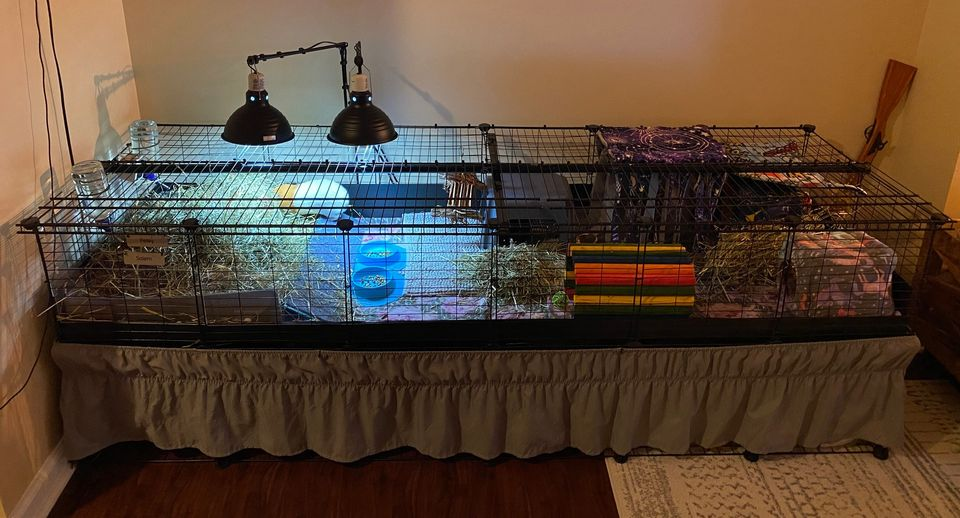
We use 13-watt tropical 5.0 UVB compact fluorescent bulbs marketed for reptiles, paired with 10-inch reflector domes. These bulbs have a relatively low UVB output compared to other bulbs. The reflectors helps direct the UVB into the enclosure, and the domes are suspended over the cage using a secure mounting arm.
The lights are positioned 12–16 inches above the cage floor. This distance is specific to our setup and should not be used as a general guideline when using different equipment. Different bulbs, fixtures, and reflectors can produce very different UVB levels at the same distance.
The UVB lighting covers half of the enclosure, over the feeding area. The other half of the cage provides an area where the guinea pigs can move away from direct UVB exposure whenever they choose. Hides and other furnishings should be arranged so that guinea pigs have comfortable areas outside the UVB zone.
We use a 12-hour timer, such as 7am to 7pm. This provides a consistent daily exposure period that replicates the natural sun, rather than leaving the UVB light on continuously.
We replace the bulb at half the manufacturer's recommended service life. For example, if the manufacturer recommends replacing a bulb every 12 months, we replace it every 6 months. This provides a margin of safety because a bulb can continue producing visible light even after its UVB output has declined. We also recommend measuring the UVI regularly rather than relying on the bulb's visible light or age alone to determine whether it is still producing the intended level of UVB.
Always keep electrical equipment safely away from hay, water, and other combustible or wet materials. Dust the reflector domes and inspect the bulbs weekly for buildup, damage, or other signs of wear. Secure the fixture and mounting hardware so that it cannot fall into the enclosure, and keep all wires safely out of reach so guinea pigs cannot chew on them.
Measuring UVB
Don't guess at UVB exposure based on bulb distance—measure it using a UVI meter. The Solarmeter 6.5R is a commonly used option among reptile keepers and is often recommended for this kind of husbandry measurement; devices like this are a specialized purchase, generally running a few hundred dollars, but they're the only reliable way to know your setup is actually producing the UVI you intend.
Take your reading at the height where your guinea pigs will actually be exposed, with the bulb, reflector, and mounting setup installed exactly as you plan to use them. Measure the strongest part of the exposure zone, and confirm your guinea pigs also have easy access to an area with little or no UVB. Don't rely on a bulb's "5.0" rating as a stand-in for actual output— different bulbs, fixtures, reflectors, and distances all produce very different real-world UVB levels.
If your measured UVI is far from the target range, adjust your setup rather than assuming the distance is fine. Recheck the UVI any time you change the bulb, fixture, reflector, or mounting height—and even without a change, plan to re-measure at least every time you replace the bulb, since output can decline well before visible light does.
Important Safety Information
Before trying UVB at home, a few things are worth checking with your exotics vet:
Existing eye conditions: Talk to your exotics vet if your guinea pig has eye problems such as cataracts, corneal damage, chronic conjunctivitis, or anything else affecting the eyes. The corneal changes discussed earlier in this article were not associated with harm in healthy animals, but that doesn't tell us what would happen in an eye that's already compromised.
Current medications: Some medications increase photosensitivity, meaning the skin and eyes become more reactive to UV exposure than normal. Enrofloxacin (Baytril) is one example—sunlight and UV exposure should be avoided while an animal is on it. If your guinea pig is on any medication, ask your vet whether it's compatible with UVB exposure before resuming or starting a UVB setup.
From there, keep these additional safety guidelines in mind:
Never force a guinea pig to stay under UVB. They should always be free to leave the exposed area and retreat to comfortable hides outside the UVB zone.
Treat UVB equipment as an electrical fire hazard. Keep the bulb, fixture, and wires away from hay, bedding, water, and chewing animals, and secure the fixture so it can't fall into the enclosure.
UVB isn't necessary for every guinea pig, and there's no officially established UVI requirement for the species. The setup described here reflects our current, ongoing experiment—and it may change as more guinea-pig-specific research becomes available.
Excessive UVB can damage the eyes and skin. A few specific signs can indicate your UVB setup needs adjusting. None of these are expected outcomes of a well-measured, conservative UVB setup, but they're worth mentioning so you can catch a problem early. If you notice any of these, discontinue UVB exposure and contact your exotics vet immediately:
- Squinting, excessive blinking, or keeping eyes partially closed
- Cloudiness or visible changes in the eyes
- Redness, irritation, or flaking on exposed skin, especially on the ears or areas with thinner fur
UVB lighting is a promising but still developing area of guinea pig care. If you decide to try it, treat it as one small, optional piece of a much bigger picture—good diet, clean water, appropriate housing, and regular veterinary care will always matter more than any lighting setup. Start conservative, measure rather than guess, and watch your animals closely for any signs that something isn't working for them. As research on UVB and guinea pigs continues to develop, we'll keep updating this article to reflect what we learn.